




From memorizing facts to asking why.
Middle school is when classical education shifts gears. Students move from absorbing the foundations into examining them — translating Latin, untangling arguments, writing essays that take a position and defend it.
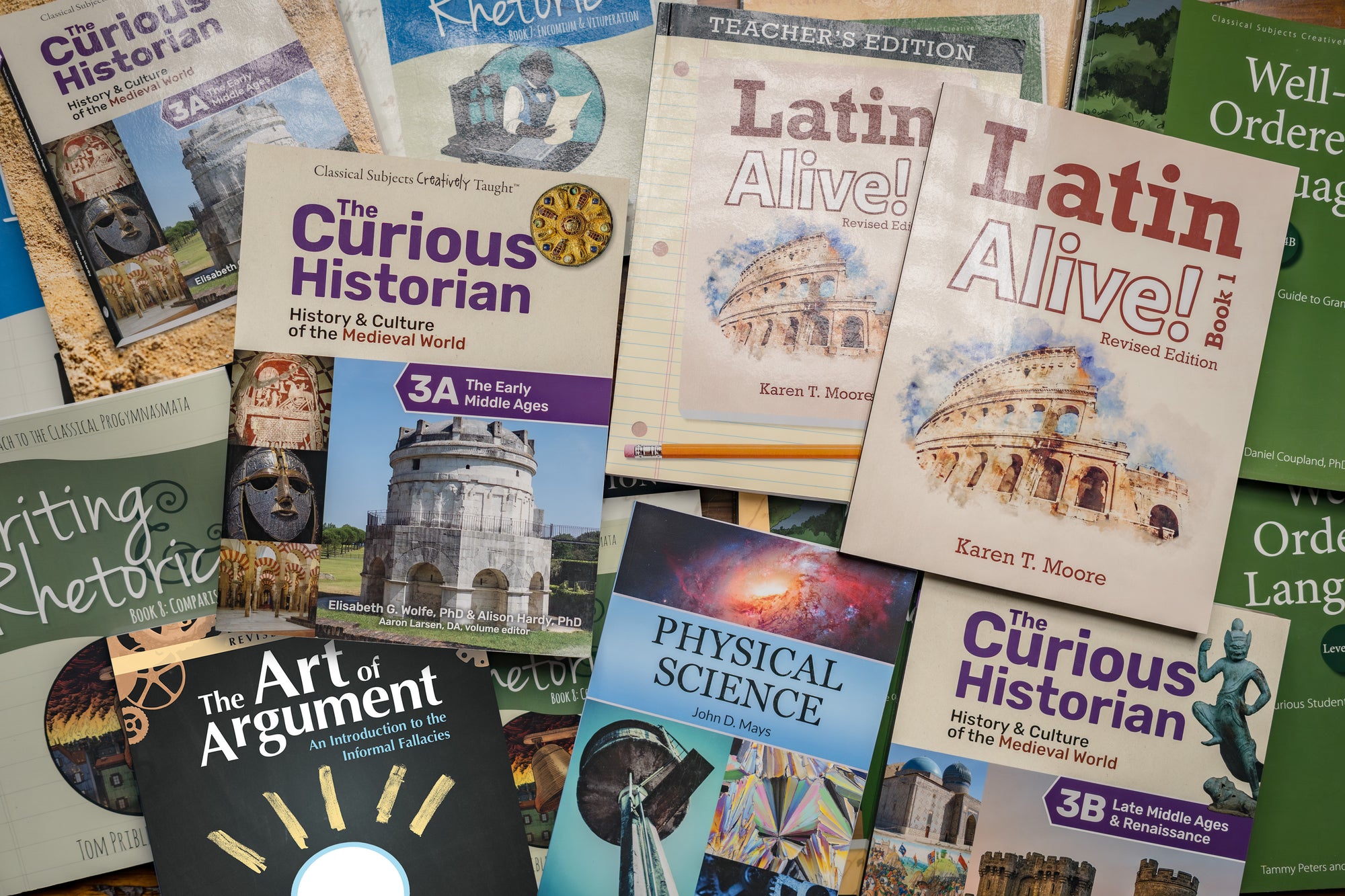
CAP's middle school curriculum is built for this moment. Latin Alive!, The Art of Argument, Writing & Rhetoric, and The Curious Historian form a coherent path through the Logic stage — not a survey course, but a real transition into intellectual maturity.
What Is the Upper Grammar Stage?
6th through 8th grade (ages 11–14) is what classical educators call the Upper Grammar stage — the bridge between the foundational Grammar years and the analytical Logic stage of the Trivium.
In the classical Trivium, students move through three stages of learning: the Grammar stage (Kindergarten through 5th or 6th grade), the Logic or Dialectic stage (6th through 8th grade), and the Rhetoric stage (9th through 12th grade). During the Grammar years, students focus on absorbing foundational knowledge, mastering language, and building habits of attention and memory. Sixth grade serves as the capstone of this stage, helping students consolidate the grammar of language, history, mathematics, and Latin before transitioning into deeper analytical work.
By 7th and 8th grade, students naturally begin asking why questions and looking for relationships between ideas, causes, and consequences. This marks the beginning of the Logic stage, where learning becomes more analytical and discussion-oriented. Students move beyond memorization into debate, formal logic, essay writing, Latin translation, and independent reasoning. History becomes an investigation of civilizations and ideas rather than simply a timeline of facts. Writing grows more structured and persuasive, while grammar and language studies become tools for clear thinking and expression.
Classical Academic Press designs its middle school curriculum specifically for this important transition. Programs such as Latin Alive!, The Art of Argument, Writing & Rhetoric, and The Curious Historian help students strengthen reasoning, analytical reading, composition, and language mastery in a coherent classical framework — equipping them to move confidently from foundational knowledge toward wisdom and intellectual maturity.

Lower Grammar (K–5th)

Upper Grammar / Dialectic (6th–8th)

Rhetoric (9th–12th)
A Year-by-Year Curriculum Overview
Jump to your student's grade to see the skills, subjects, and programs that fit each year of the Upper Grammar stage.

Classical Homeschool Curriculum for 6th Grade
A classical 6th grade curriculum serves as the capstone of the Grammar stage while preparing students for the analytical work ahead. Many students complete Latin for Children Primer C or transition into Latin Alive! Level 1, where Latin shifts from vocabulary memorization into translation and grammar analysis.
Formal grammar deepens through Well-Ordered Language Levels 3–4, while Writing & Rhetoric Books 9–10 develop structured composition and persuasive writing. Students engage with medieval history through The Curious Historian and begin scientific observation through Novare Life Science.
Core Focus: Latin for Children C / Latin Alive! 1 · Well-Ordered Language 3–4 · Writing & Rhetoric 9–10 · The Curious Historian Level 3 · Life Science · Informal Logic Intro

Classical Homeschool Curriculum for 7th Grade
A classical 7th grade curriculum marks the beginning of the Logic stage, when students naturally begin questioning, analyzing, and debating ideas rather than simply memorizing information. Students typically begin Latin Alive! Level 1, strengthening translation skills and grammatical analysis.
Formal reasoning becomes central through The Art of Argument, where students learn to recognize informal fallacies and evaluate arguments thoughtfully. Writing & Rhetoric advances composition, while The Curious Historian continues historical analysis. CAP's Grade Kit 6/7 aligns naturally with this transition.
Core Focus: Latin Alive! Level 1 · The Art of Argument (Informal Logic) · Writing & Rhetoric · The Curious Historian · Novare Physical Science · Analytical Thinking

Classical Homeschool Curriculum for 8th Grade
A classical 8th grade curriculum deepens the Logic stage and prepares students for the more sophisticated work of high school. Students progress into Latin Alive! Level 2, where translation, syntax, and grammatical precision become increasingly advanced.
Formal reasoning expands through The Discovery of Deduction, introducing students to syllogisms and deductive reasoning. Writing moves toward advanced essays and rhetoric foundations through continued work in Writing & Rhetoric. CAP's Grade Kit 7/8 aligns closely with these goals.
Core Focus: Latin Alive! Level 2 · The Discovery of Deduction (Formal Logic) · Advanced Essay Writing · Rhetoric Foundations · History & Science Analysis · High School Prep
Core Subjects Across 6th–8th Grade
Every CAP subject is designed to stand on its own or work together — building toward fluency in language, logic, and the great conversation of ideas.


CAP Grade Kits for Middle School
CAP Grade Kits bundle core subjects into a coherent, full-year middle school curriculum — Latin, grammar, writing, history, and logic, integrated so students develop skills across disciplines in a connected way.
The 5th/6th Grade Kit helps students complete the Grammar stage through advanced language study, composition, and history. The 6th/7th Grade Kit introduces the Logic stage through Latin, formal writing, and introductory logic.
Because placement depends on prior experience and readiness, review the Grade Kits page and the FAQ to find the right starting point for your student.

Who This Curriculum Is For
Families homeschooling 6th, 7th, or 8th graders (ages 11–14) who want a rigorous, coherent classical education.
Students completing the Lower Grammar stage and preparing to enter the analytical Logic stage of the Trivium.
Families new to Classical Academic Press at the middle school level — including those switching from Memoria Press, Veritas Press, or secular curricula.
Co-ops, cottage schools, and hybrid programs serving 6th–8th grade classical students.
Parents of advanced 5th graders who need a strong bridge into formal logic, Latin, and high school–level academics.
Why Classical Academic Press for Middle School

Award-Winning Curriculum
Honors for The Art of Argument, Latin Alive!, and Writing & Rhetoric, along with multiple Practical Homeschooling Reader Awards reflecting long-term parent and educator trust.

Expert Scholars Who Teach
Dr. Christopher Perrin (Latin Alive!), Aaron Larsen and Dr. Joelle Hodge (The Art of Argument and The Discovery of Deduction), and Novare science author John Mays — working classical educators behind every series.

Logic-Stage Specialists
Few publishers offer a dedicated, rigorous informal-to-formal logic sequence for 7th and 8th grade. The Art of Argument and The Discovery of Deduction are the leading classical materials for this transition.

Coherent Across Years
Every subject series builds systematically across grade levels — not a collection of standalone workbooks. Students arrive at Upper Grammar already prepared.

High School Readiness
Students completing CAP's 8th grade materials are well-prepared for the Rhetoric stage and advanced high school coursework in Latin, logic, history, and writing.

Authentically Classical
Every CAP product is rooted in the classical Trivium. Subjects integrate naturally and form a coherent whole — not an eclectic patchwork.
Frequently Asked Questions
What is the Upper Grammar stage in classical education?
What is the Upper Grammar stage in classical education?
The Upper Grammar stage is the transition between the foundational Grammar years and the more analytical Logic stage of the classical Trivium. It generally covers 6th through 8th grade (ages 11–14), though classical educators sometimes describe 6th grade as the capstone of the Grammar stage and 7th–8th as the beginning of the Logic or Dialectic stage.
During these years, students move from mastering facts and language patterns into reasoning, analysis, and structured argumentation.
Is this curriculum for middle school students?
Is this curriculum for middle school students?
Yes. This curriculum is specifically designed for middle school students in 6th through 8th grade (ages 11–14). Sixth grade focuses on completing the Grammar stage through advanced language and writing work, while 7th and 8th grade introduce Logic-stage learning through formal reasoning, analytical writing, and deeper historical study.
Both “Upper Grammar” and “Logic stage” are commonly used terms for this transition period.
How is 6th–8th grade classical curriculum different from earlier grades?
How is 6th–8th grade classical curriculum different from earlier grades?
In the earlier Grammar years, students focus heavily on memorization, foundational language skills, and habit formation. By 6th through 8th grade, learning becomes increasingly analytical as students begin Latin translation, formal logic, persuasive writing, and historical analysis.
Students are no longer simply absorbing information — they are learning to question, compare, argue, and reason clearly.
What if my student is new to classical education in 6th grade?
What if my student is new to classical education in 6th grade?
Many families begin classical education during middle school, and CAP provides flexible entry points for new students. Placement depends on prior experience in grammar, writing, and Latin, so families should review placement recommendations and prerequisite guidance before choosing a level.
Students can often begin with introductory versions of Latin, writing, or logic while still joining grade-level history and humanities studies.
Does my student need prior Latin experience for this curriculum?
Does my student need prior Latin experience for this curriculum?
Not necessarily. Students coming from Latin for Children typically transition naturally into Latin Alive! Level 1 during 6th or 7th grade. Students without prior Latin experience can still begin with introductory Latin pathways and progress successfully with proper placement and pacing.
What logic curriculum do you recommend for 7th and 8th grade?
What logic curriculum do you recommend for 7th and 8th grade?
For 7th grade, CAP recommends The Art of Argument, which introduces students to informal logic and common logical fallacies. In 8th grade, students typically move into The Discovery of Deduction, a formal logic curriculum covering syllogisms and deductive reasoning.
Together, these programs create a rigorous informal-to-formal logic sequence designed specifically for classical middle school students.
Do you offer a complete grade-level package for 6th, 7th, or 8th grade?
Do you offer a complete grade-level package for 6th, 7th, or 8th grade?
Yes. CAP offers integrated Grade Kits for 6/7 and 7/8 that bundle core subjects such as Latin, grammar, writing, history, and logic into a coherent full-year curriculum. These kits are designed to provide consistent pedagogy and integrated skill development across subjects.
Families can explore placement guidance and kit options on the Grade Kits page.
What comes after 8th grade in a classical homeschool curriculum?
What comes after 8th grade in a classical homeschool curriculum?
After 8th grade, students move fully into the Rhetoric stage of the classical Trivium, where they focus on advanced analysis, persuasive communication, and wisdom-oriented learning. CAP offers high school humanities, logic, Latin, rhetoric, and science programs through its Dialectic & Rhetoric collections, along with online courses through Scholé Academy.
These programs prepare students for advanced academic work and thoughtful engagement with great ideas.
Ready to Begin?
Shop our middle school curricula or reach out to our team to find the perfect classical fit for your family or school.